

TAU Kuber
TAU Kuber is a platform for launching and managing Kubernetes and containerized applications. It enables a quick transition to using containers and offers the lowest TCO on the market.

years of development

built-in modules

specialists on the team
Platform FEATURES
—
Platform FEATURES
—
Platform FEATURES
Simple
Management
Management

Unified, User-Friendly Interface
Administer all clusters from a single interface without switching between systems

End-to-End Access Model
Assign permissions at the platform, cluster, namespace, or node level

One-Click Cluster Creation
Deploy new clusters quickly and in accordance with security policies
Built for Teams of Any Level
An intuitive GUI for beginners, with plenty of automations, hints, and checks. Plus there are advanced IaC and GitOps capabilities for experts.
Run Containers Where It's Convenient for You
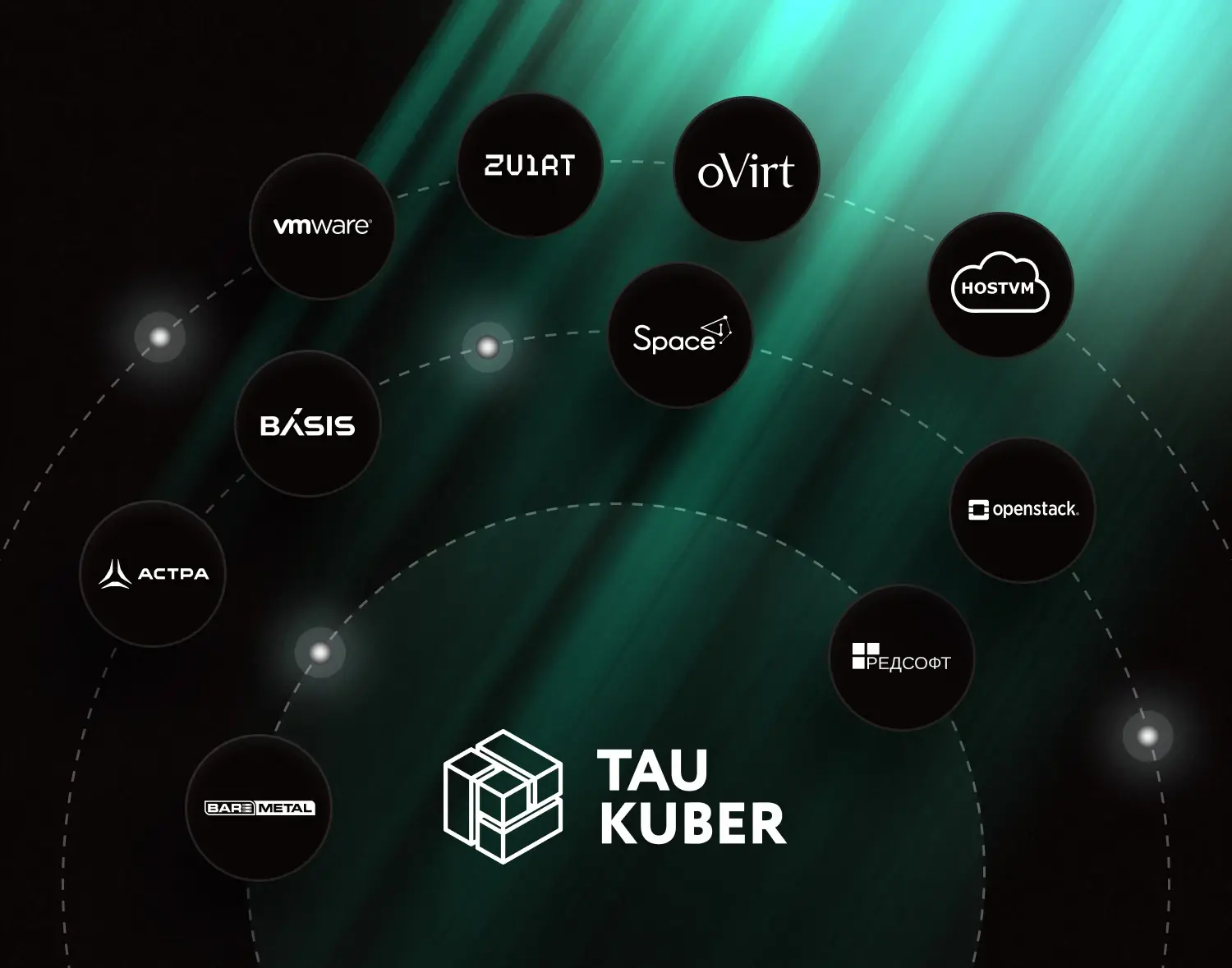
Deploy TAU Kuber clusters on bare metal or virtualization, in a closed network without internet access. Or deploy it in the cloud and consume it as a service.
Free Community Edition — for Your Start

Minimum system requirements:
1 host, 6 CPU, 8 GB RAM, 80 GB SSD
1 host, 6 CPU, 8 GB RAM, 80 GB SSD
Leave a request — we will send you a license key, product links, documentation, and training materials.
Platform with no feature limitations
Up to 10 worker nodes per installation

Why Choose TAU Kuber
Fast Start
The platform is ready for deploying Kubernetes clusters 20 minutes after installation.

Predictable Release Cycle
Three major releases annually plus patch updates as needed.

Local Development
The product is created in Uzbekistan. Open Source components are built from source code using a secure pipeline.

Automatic Updates
All platform components are updated automatically or on request.

Closed Network
Deploy the platform without internet access and without external dependencies.

Security Out of the Box
Built-in security mechanisms and integration with Container Security solutions — without additional configuration.

Industry Use Cases

Telecom
Building Telco Cloud infrastructures and NFV platforms
DPDK and SR-IOV support
Handling workloads exceeding 25 Gbit/s per pod
Support for low-latency scenarios

Banking and Fintech
Automatic scaling during peak loads
Compliance with regulatory requirements
Building online banking platforms and Anti-Fraud systems
Big data processing and zero-downtime updates

Industry and Manufacturing
Inference and training of ML models on GPUs
Edge computing and building HPC clusters
Deployment of modern MES/SCADA systems
Industrial IoT and data analytics

Retail
Deployment of E-commerce, WMS, SCM, and other application platforms
Optimization of predictive ML models
Native operation in Managed K8s and hybrid clouds
Fast hypothesis testing and A/B testing
Release 2.12.0 introduces support for a new infrastructure, enhances the cluster management utility, and improves the platform GUI.
Product Releases
v2.12.0
2025 Q4

Shtil Utility
Implemented the ability to delete the management cluster.
Increased fault tolerance during temporary network failures.
Accelerated detection and resolution of installation errors: the utility now logs the results of checking compliance with minimum system requirements.
Graphical Interface
Implemented graphical separation of cloud solution providers into separate groups: OpenStack, VK Cloud, Selectel.
Detailed cluster deployment and update statuses.
Grouped oVirt-like solution providers into separate groups: oVirt, RED Virtualization, zVirt, HostVM, and ROSA Virtualization.
Infrastructure
Added support for Ubuntu 24.04 OS and integration with the Tatlin. Unified storage system.
Expanded the list of supported providers for management cluster installation: OpenStack, Selectel, and VK Cloud.
Integrated tools for configuring the OpenStack cloud provider — Cloud Controller Manager and Cinder CSI.
In release 2.11, we focused on simplifying installation and expanding logging and monitoring capabilities.
v2.11.0
2025 Q3
Logging
Replaced OpenSearch with VictoriaLogs — the platform's own solution with lower computing resource consumption.
Added log viewing, filtering, and exporting in the cluster interface.
Expanded log storage and rotation settings: parameters can now be flexibly configured according to infrastructure requirements.
Graphical Interface
Redesigned the namespace dashboard: administrators now get up-to-date application status information faster.
Added service publishing: a list of available Ingress and Services linked to workloads.
Implemented quick actions: creating Workloads, Ingress, and Services in one click.
Improved display of existing blocks: workload monitoring (status, pod restarts, detected vulnerabilities), resource consumption analysis.
Added service availability monitoring to the dashboard for operational tracking of cluster component status and quick response to failures.
Integrations
Added support for the vCloudDirector provider: users now have access to Kubernetes as a Service in the Nubes cloud. KaaS based on TAU Kuber — ready-made Kubernetes clusters in the cloud with 99.95% SLA.
Cluster Deployment
Implemented a new installer with a graphical interface and Cluster API support.
Expanded the client cluster creation process: added quick certificate setup, support for corporate and ACME certificates, improved the system service selection mechanism.
Release 2.10.0 includes three areas of improvement: infrastructure, integrations, and management.
v2.10.0
2025 Q2
Integrations
Implemented a Cluster API provider for Yandex Cloud: the platform now supports the full automated cluster management lifecycle, including autoscaling and self-healing.
Added support for the ALD Pro catalog, completing coverage of common LDAP directories.
Included the Luntry repository in the platform marketplace to connect an additional security tool with confirmed compatibility.
Management
Implemented a tenant mechanism for grouping heterogeneous objects under unified management: multiple entire clusters, multiple namespaces of one cluster, multiple namespaces of different clusters.
Added tenant lifecycle management and access rights segregation at the tenant level.
Infrastructure
Added support for installing the platform on a single master node. Minimum requirements: one host with six CPUs, 8 GiB of RAM, and 80 GiB of disk.
Expanded the list of supported OSs: added Onyx OS with kernel version 6.6 to RED OS, Astra Linux, Rosa, and Rocky Linux.
Release 2.9.0 added support for installation on Windows, new logging and monitoring components based on Vector and VMAgent, and improved certificate and access rights management.
v2.9.0
2025 Q1
Graphical Interface
Simplified the operating mode with the Shturval v2 provider.
Added SecurityContext configuration in workload objects.
Optimized user and group search when assigning access rights.
Fixes
Fixed deletion of UserRoles when deleting a cluster.
Fixed an error restoring from backups: the velero namespace no longer appears in backups.
Adjusted backup deletion logic after storage deletion.
Infrastructure
Implemented support for installing TAU Kuber on a workstation with Windows OS.
Added a new log collection component based on Vector.
Added a new metric collection component based on VMAgent.
Expanded certificate support: added rotation (ACME) and installation of wildcard certificates for the mirror.
Release 2.8.0 introduced the Community edition of the platform, a Stand-alone management cluster, support for Astra Linux SE 1.8, and expanded graphical interface capabilities, including English language support.
v2.8.0
2024 Q4
Graphical Interface
Added English language support.
Split dual sections in node configuration (NCI).
Expanded the status model in access management and the access tree.
Updated the "Platform" dashboard design.
Fixes
Fixed installation in a conditionally closed network on Rocky Linux OS.
Fixed an error clearing role assignment information in ArgoCD.
Fixed node drain launch from the graphical interface.
Restored correct saving of the nodeVolumeDetachTimeout value when adding a worker node group.
Infrastructure
Added Stand-alone mode for the management cluster.
Released the Community edition of the platform.
Implemented node certificate management for RHEL.
Expanded installation configuration: added ACME server parameter settings during management cluster deployment.
Added support for the OCI protocol for connecting repositories to clusters.
Added support for Astra Linux SE 1.8.
Replaced Kube-bench with Trivy Operator.
Get a Product Demo
Software cost is calculated individually.
For pricing, contact us via the form or at email:
demo@tau-kuber.uz
demo@tau-kuber.uz
FAQ
Can the platform be deployed on-premise?

Yes. On-premise installations are supported in open and closed networks, both on bare-metal and in virtualized environments.
Is TAU Kuber suitable for large businesses?
TAU Kuber was originally designed for enterprise needs. Small companies and developers can use the free Community edition.
What business benefits does the platform provide?
Freeing up engineering resources, reducing Time to Market, and lowering the operational burden on microservice infrastructure.
How does TAU Kuber differ from standard Kubernetes?
Unlike "vanilla" K8s, TAU Kuber includes monitoring, logging, traffic management, a flexible out-of-the-box role model, and 20+ modules that simplify DevOps work.
How does the platform ensure Kubernetes cluster security?
The platform has a built-in vulnerability analysis mechanism for configurations and container images based on Trivy.
All components are built from source in Uzbekistan and go through a secure development pipeline.
Control over all platform elements is possible.
Integrations with additional security overlays are available.
© 2026 ООО «D-TAU GROUP»
